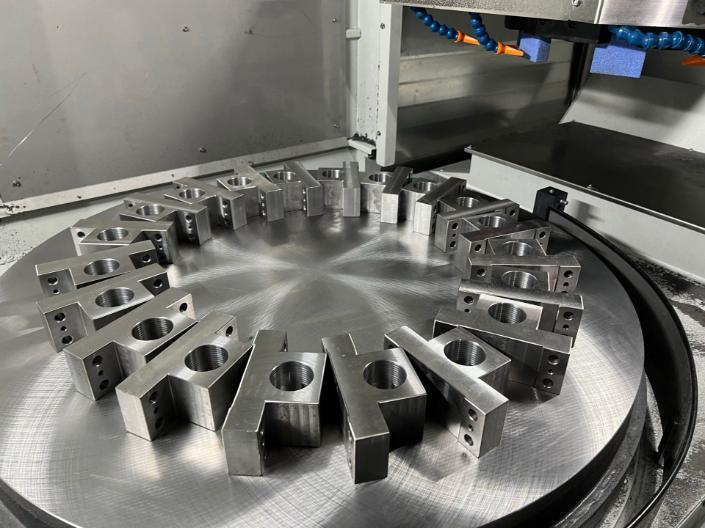
In mold manufacturing, large-area surface machining and high flatness control are critical factors affecting both product quality and production efficiency.
For mold manufacturers, the challenge is not only achieving precision, but also maintaining productivity when machining large workpieces.
As mold sizes increase and precision requirements become more demanding, the limitations of conventional reciprocating grinding in terms of efficiency and stability are becoming more apparent. As a result, rotary grinding has become a preferred solution in the mold industry.
Large-Area Machining: Efficiency Becomes Critical
Mold processing often involves large-area material removal. Insufficient machining efficiency can directly impact overall production efficiency and delivery schedules.
Rotary grinding enables continuous rotation of the workpiece, allowing stable contact between the grinding wheel and the surface, significantly improving material removal rates and reducing machining time.
Compared with conventional reciprocating grinding, rotary grinding offers a more continuous machining process with less idle stroke time, making it more efficient for large-area grinding and better suited to medium-to-large mold applications. In contrast, reciprocating grinding is more likely to involve repeated back-and-forth movement, which can reduce efficiency in large-surface machining.
High Flatness Requirements: Motion Accuracy Determines Quality
Surface flatness directly affects mold performance and product consistency.
During large-area grinding, insufficient machine rigidity or lack of motion accuracy can lead to localized errors and flatness deviation.
With a continuous machining path, rotary grinding helps reduce cumulative errors. Combined with a high-rigidity structure and stable guideway system, it ensures consistent flatness even during long-term operation.
Tong Yi Rotary Grinding Machines: Balancing Efficiency and Precision
To meet the demands of mold manufacturing, Tong Yi rotary grinding machines are engineered to deliver both high efficiency and precision:
- High-rigidity machine structure: Utilizing Meehanite cast iron for superior vibration damping and deformation resistance
- Stable spindle system: Ensuring consistent cutting performance and improved material removal efficiency
- Precision guideway configuration: Maintaining feed accuracy and consistency during long-term operation
Through optimized structural design, Tong Yi machines maintain stable performance under heavy loads and continuous operation.
The Optimal Balance Between Efficiency and Flatness
In the mold industry, grinding equipment must deliver not only high precision but also high efficiency and long-term stability.
Rotary grinding has become a key solution for large-area, high-precision machining by combining process advantages with advanced machine design.
Tong Yi continues to advance grinding technology, helping manufacturers improve efficiency while consistently achieving high flatness standards.
Tong Yi Rotary Grinding Machines — Engineered for Efficiency and Precision.