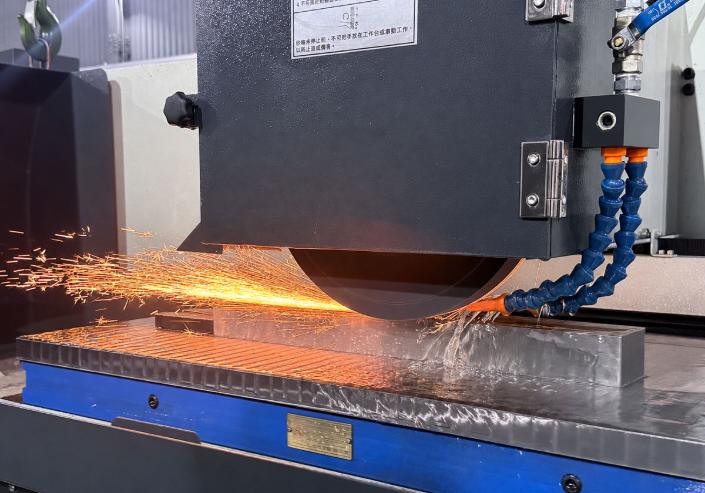
In precision surface grinding, a machine may deliver excellent accuracy at the start of production. However, as operating hours increase, heat buildup can gradually affect dimensional accuracy and machining quality.
For manufacturers running continuous production, thermal stability has become a key factor in maintaining consistent machining performance, reducing rework, and improving overall productivity.
Why Does Grinding Accuracy Change During Long Production Runs?
During continuous operation, heat is generated by the spindle, motors, hydraulic system, and the grinding process itself. As this heat accumulates, thermal expansion and thermal drift can gradually affect machine positioning and structural stability.
This can result in:.
- Dimensional variation
- Reduced flatness and parallelism
- Inconsistent surface finish
- Lower batch-to-batch consistency
Maintaining long-term accuracy depends not only on machining capability, but also on how effectively the machine controls thermal drift during extended production runs.
Main Sources of Heat in Grinding Machines
In a surface grinding machine, heat can come from several sources during long-hour operation, including:
- Spindle rotation and bearing friction
- Motor and hydraulic system operation
- Contact between the grinding wheel and workpiece
- Coolant temperature fluctuation
- Changes in the surrounding shop environment
When these thermal factors are not evenly controlled, they can influence machine geometry and lead to gradual accuracy deviation over time.
How Thermal Drift Impacts Workpiece Quality
Even small thermal shifts can affect workpiece quality over long production cycles. When machine components expand unevenly, the result may be subtle changes in table movement, spindle position, or grinding wheel contact.
Over time, this can lead to reduced dimensional accuracy, weaker flatness and parallelism control, and less consistent surface finish. For manufacturers producing precision parts in batches, controlling thermal drift is essential for maintaining repeatable results.
What Helps Improve Thermal Stability in Grinding Machines?
Thermal stability is achieved through overall machine design rather than a single component. In surface grinding machines, long-term performance depends on how effectively the machine manages heat generation and heat distribution throughout continuous operation.
When evaluating a grinding machine, look for:
- A high-rigidity machine structure
- A stable spindle system with controlled heat generation
- Precision guideways for long-term positioning accuracy
- An optimized structure that promotes balanced heat distribution
These features help minimize thermal drift and maintain stable machining performance during extended production.
How Tong Yi Designs for More Stable Long-Hour Grinding Performance
Tong Yi continuously optimizes machine structures and key components to improve long-term machining stability.
Key features include:
- High-rigidity Meehanite cast iron structure
- High-precision spindle system
- Precision guideway configuration
- Optimized structural design for improved thermal stability
Through continuous engineering refinement and strict quality control, Tong Yi grinding machines help manufacturers reduce thermal drift, improve machining consistency, and enhance production efficiency.
Thermal Stability Supports Long-Term Grinding Precision
Precision is measured not only by initial accuracy but also by a machine's ability to maintain consistent performance over time.
A grinding machine with excellent thermal stability helps reduce machining errors, improve yield, and maximize long-term productivity.
Tong Yi Grinding Machines — Engineered for Long-Term Stability and Precision.